
GPS & Training Load Monitoring for Football
External and internal load analysis for football clubs — STATSports, Catapult, WIMU or Sonra data turned into a weekly report your staff can act on.
GPS data is only useful if it changes the training week
Most clubs already wear GPS vests every day. The difficulty is turning thousands of rows into an answer to three questions: did each player get the load we planned, who is above or below their normal range, and who is ready for the next match?
GPS and training load monitoring by V High Performance combines external load (what the player did) with internal load (how hard it was for them), and reads both in the context of the microcycle and the match calendar.
The metrics that matter to a football staff
The list is kept short on purpose. A report that shows everything gets read by nobody.
Volume
Total distance and session duration, compared with the planned session and the player's own recent average.
High-speed running & sprinting
HSR and sprint distance, number of sprints and exposure to near-maximal speed — key for both performance and safe return to play.
Accelerations & decelerations
Mechanical load from high-intensity accelerations and decelerations, especially relevant in small-sided games and MD-3/MD-4 sessions.
Internal load & wellness
Session-RPE and daily wellness (sleep, fatigue, soreness, stress, mood) to see how the same load is tolerated by each player.
A weekly monitoring routine built around the microcycle
Collect & clean
Session exports are checked for missing units, wrong player IDs, drills to exclude and partial sessions before any number reaches a report.
Compare with the plan
Each session is labelled by match day (MD-4 to MD+1) and compared with the load the staff planned for that day.
Compare with the player
Last 7 days are compared with each player's own 4-week reference and with his match demands, so a centre-back is not judged against a winger.
Report & discuss
A one-page report lists the players to review and why. The staff decide; the data starts the conversation.
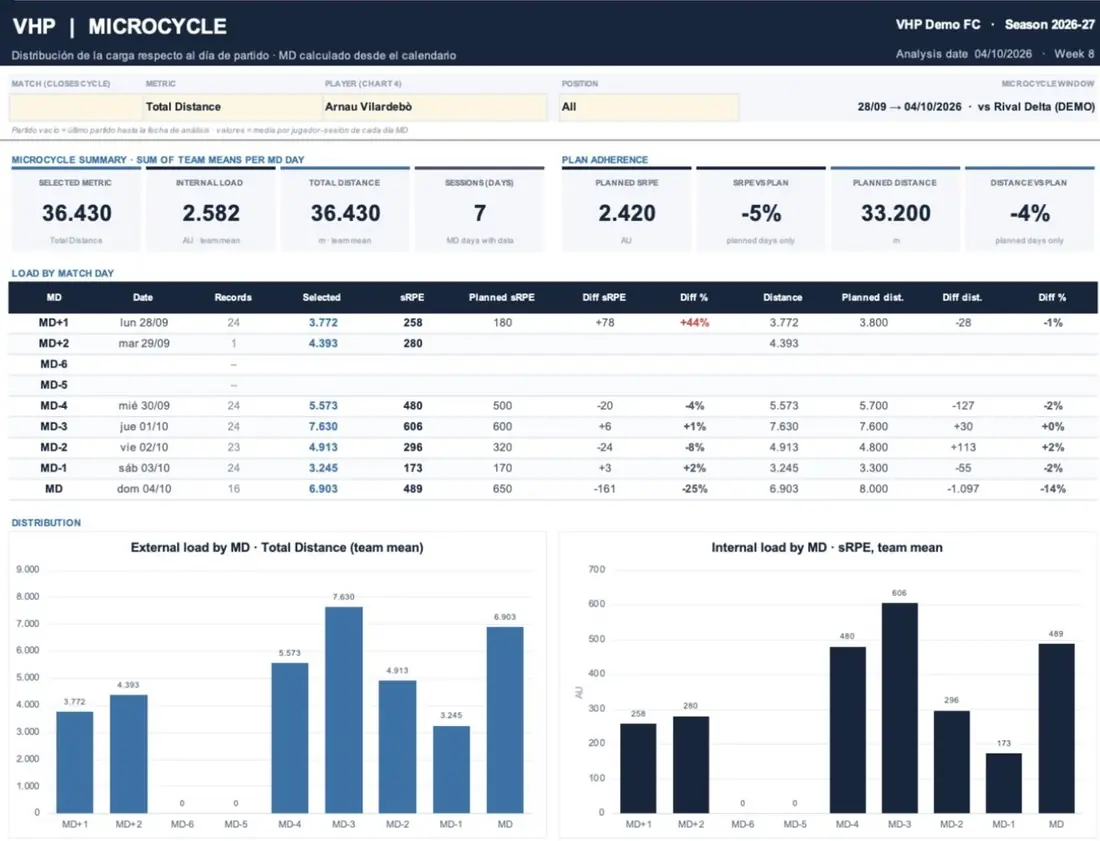
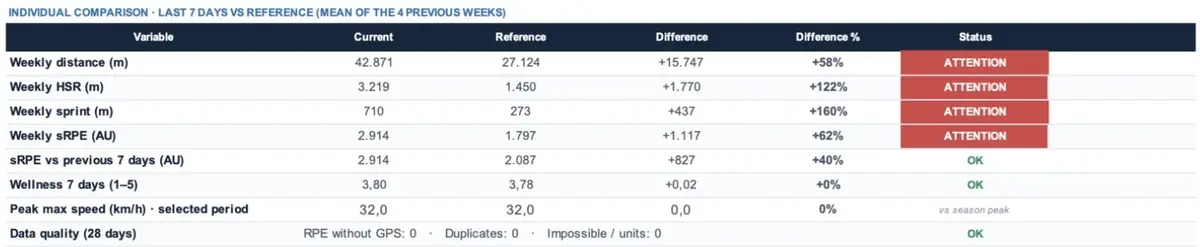
After a Sunday match, the substitutes' high-speed running for the week sits well below their own reference. The Monday report flags them, and the staff add a short compensatory running block on MD+1 instead of finding out two weeks later when a player returns to the starting eleven.
Return to play with GPS
For injured players, GPS data is used to build objective running progressions with the medical team: distance, high-speed running and sprint exposure are progressed towards the player's own match demands before he rejoins full team training.
The monitoring feeds directly into the performance dashboards and is usually part of a wider football performance consulting engagement. You can also download a sample weekly report (PDF, Spanish).
Frequently asked questions
Which GPS systems do you work with?
STATSports, Catapult, WIMU and Sonra exports, as well as CSV or Excel exports from other providers. If your system can export session data, it can be integrated.
Which speed thresholds do you use for high-speed running and sprinting?
Your club's own thresholds, so reports stay consistent with what your staff already use. If the club has none, we agree absolute thresholds first and add individualised ones (relative to each player's maximum speed) where it makes sense.
Can you predict injuries from GPS data?
No, and nobody can do that reliably. Load monitoring helps the staff spot players whose recent load deviates from their own normal range, so the coach and medical staff can have the right conversation early. Decisions remain with the staff.
Do you also monitor internal load?
Yes. Session-RPE (RPE × minutes) and daily wellness questionnaires are combined with GPS data, because the same external load can feel very different to two players.
How quickly is the data processed?
The usual routine is same-day processing for sessions and next-morning reports after matches, but timing is agreed with each club around its microcycle.
Other ways V High Performance can help
Want to talk about your club's performance process?
Tell me how your staff currently plans, monitors and reports — I'll reply with a practical first step.
Get in touch